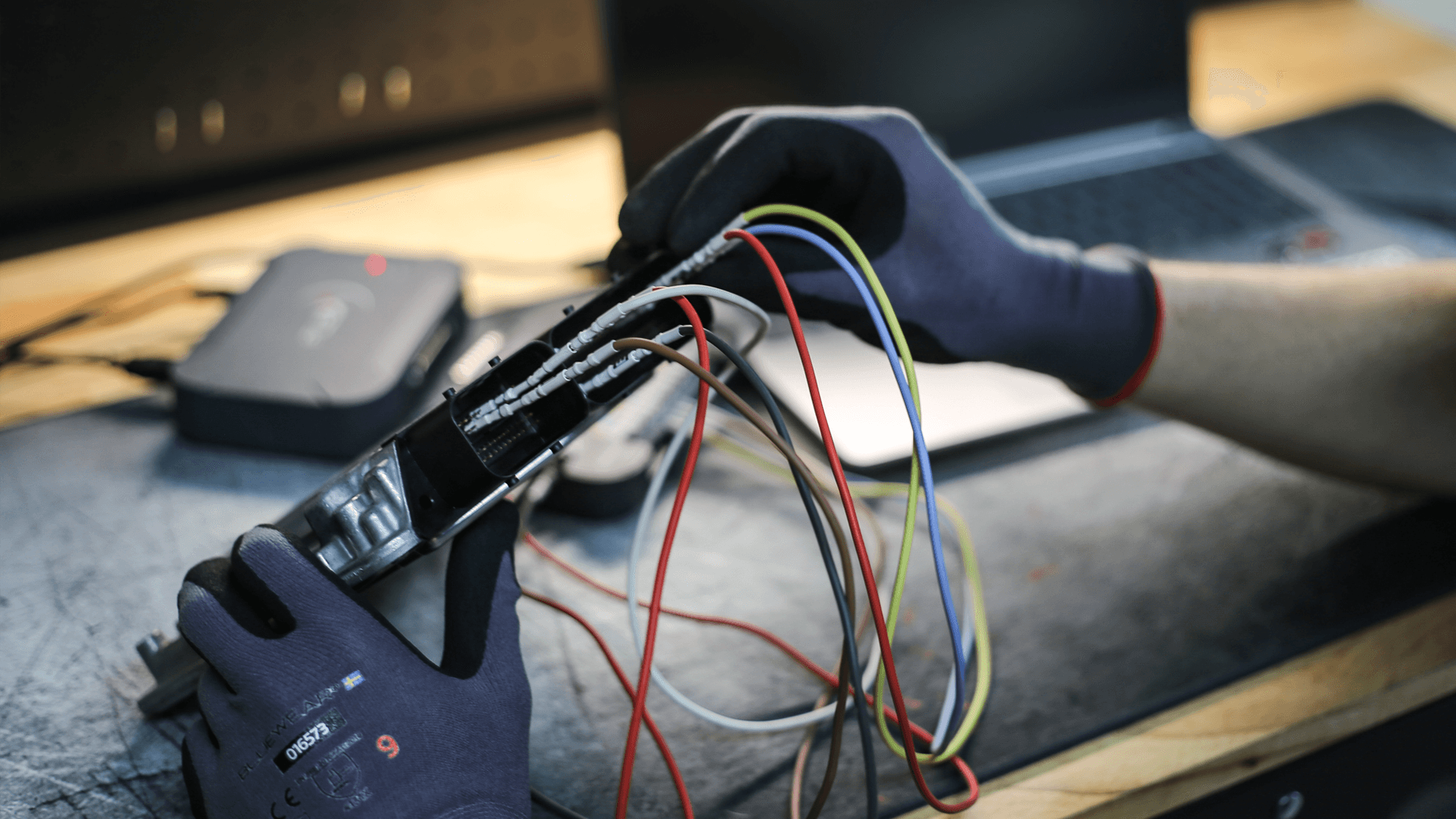
Stage 1 Files for BMW and MINI
A good Stage 1 tune starts with the right information, not the model badge on the tailgate. Two BMW 320d models or MINI Cooper S models may have different engines, engine control units and software versions. A modified file must therefore be matched to the specific vehicle and its original software.
Revtech Files provides tested engine tuning files and technical support from real technicians. Our file service is open 24/7 and is operated by Fileservice Scandinavia AB in Kalmar, Sweden. For BMW and MINI, the aim is to find the right solution for the vehicle’s actual configuration. Availability and compatibility must always be confirmed using the ECU information—a model list does not guarantee support for every variant.
What Is a Stage 1 File?
A Stage 1 file is a modified calibration for the engine control unit (ECU). Stage 1 tuning generally refers to a vehicle with standard hardware and no requirement for major mechanical changes. However, the term is not a uniform technical standard, so the requirements must be specified for each job.
On a turbocharged engine, the work may include coordinated adjustments to areas such as:
- Torque request and relevant torque limiters.
- Boost pressure and turbocharger control.
- Fuel quantity and injection strategy.
- Ignition on petrol engines, taking fuel quality and knock control into account.
- Interaction between the engine management system and the transmission.
This is not simply a matter of increasing one parameter. The calibration needs to work as a complete system and account for the engine, turbocharger system and drivetrain. Naturally aspirated engines generally offer more limited tuning potential than forced-induction engines.
BMW: Identify the Right Model and Generation
When searching for Stage 1 files for BMW, the model and generation are a useful starting point. For an actual file job, however, you will also need the engine variant, ECU identification and software version.
The following model families and generations are relevant when preparing an enquiry. This list is intended to help with identification; it is not a guarantee of support for every engine and ECU combination.
BMW 1, 2, 3 and 4 Series
- 1 Series: E81, E82, E87 and E88; F20 and F21; F40 and F70.
- 2 Series: F22 and F23; F45 and F46; F44; G42 and U06.
- 3 Series: E46; E90, E91, E92 and E93; F30, F31 and F34; G20 and G21.
- 4 Series: F32, F33 and F36; G22, G23 and G26.
Badges such as 118i, 120d, 220i, 320d, 330i and 430d are not enough on their own to select a file. The same model designation can be used with different engine generations and software, depending on model year and market.
BMW 5, 6 and 7 Series
- 5 Series: E60 and E61; F10, F11 and F07; G30 and G31; G60 and G61.
- 6 Series: E63 and E64; F06, F12 and F13; G32.
- 7 Series: E65 and E66; F01 and F02; G11 and G12; G70.
For models such as the 520d, 530d, 535i and 540i, the workshop needs to verify the exact drivetrain. Hybrid versions and other more complex drivetrains require a separate assessment; a file for a conventional petrol or diesel variant is not automatically suitable.
BMW X Models and Z4
- X1: E84, F48 and U11.
- X2: F39 and U10.
- X3 and X4: E83, F25, G01 and G45; F26 and G02, respectively.
- X5 and X6: E53, E70, F15 and G05; E71, F16 and G06, respectively.
- X7: G07.
- Z4: E85, E86, E89 and G29.
The drivetrain, transmission and engine variant should be included in the information you provide. M models also need to be identified separately: an M Sport package does not mean the car has the same drivetrain as a BMW M model.
MINI: Cooper, Cooper S and Other Model Families
MINI also has significant technical differences between generations. Names such as One, Cooper, Cooper S and John Cooper Works do not, by themselves, identify the ECU or engine software used by the vehicle.
Common generations to include in an enquiry are:
- Early MINI models: R50 and R53, plus the R52 convertible.
- Next generation: R56, Clubman R55 and convertible R57.
- Coupé and Roadster: R58 and R59.
- Countryman and Paceman: R60 and R61.
- Later hatchback and convertible: F55, F56 and F57.
- Later Clubman and Countryman: F54 and F60.
- Newer models: F65, F66, F67 and Countryman U25.
The difference between an early supercharged Cooper S and a later turbocharged Cooper S affects the engine tuning requirements. Electric vehicles, including electric MINI models, should not be treated as conventional Stage 1 jobs for internal combustion engines.
Tested Files—But Correct Matching Still Matters
Revtech Files supplies tested files. This does not mean that one file suits every BMW or MINI, or that every possible variant can be confirmed without checking the vehicle information.
To assess your job, the information provided will normally need to include:
- Model, generation, model year and engine designation.
- Standard power output and transmission type.
- ECU type and available hardware and software numbers.
- Reading tool, protocol and reading method.
- The original file or a correctly identified virtual read, where supported by the tool.
- Information about mechanical modifications, previous tuning and current fault codes.
Read more about how our engine tuning file service works before preparing your first job.
OBD, Bench and Boot
OBD means communicating through the vehicle’s diagnostic port. Bench means connecting the tool directly to the ECU terminals. Boot may require the ECU to be opened to access specific connection points.
The appropriate method depends on the ECU, its protection level and tool support. Do not choose a method based solely on the vehicle model. Check the tool manufacturer’s instructions and ensure a stable power supply during programming.
Checks Before and After Programming
A modified file will not repair mechanical faults. Check the vehicle’s condition before starting work, especially if it has rough running, boost pressure deviations, overheating or emissions system problems.
A practical workflow is to:
- Read and assess fault codes before programming.
- Check the service history and relevant mechanical systems.
- Save the original file and ECU identification details.
- Confirm that the file matches the correct software version.
- Ensure checksums are handled correctly. Checksums are used to verify data integrity.
- Follow up with diagnostics and relevant data logging after programming.
Avoid writing a file from another vehicle just because the model name and standard power output appear to match. Even small software differences can make a file unsuitable.
Is Transmission Tuning Also Needed?
Not automatically. The transmission control unit (TCU) can affect how engine torque is managed, but the need for transmission tuning must be assessed separately. Clutch condition, transmission type and drivetrain limits are relevant even when only the engine management system is being changed.
Power, Regulations and Realistic Expectations
It is not possible to give a credible power result based only on the words BMW, MINI or Stage 1. The engine variant, fuel, vehicle condition and calibration all affect the outcome. Ask for an assessment of your specific vehicle rather than comparing generic maximum figures.
Also check how a modification may affect insurance, warranty and vehicle approval. Requirements can differ across jurisdictions in Sweden and the rest of the EU, as well as in the UK and the US. A Stage 1 tune does not automatically mean that the vehicle continues to meet all applicable requirements. Disabling emissions controls is not a prerequisite for a standard Stage 1 tune.
Get Started with Revtech Files
For workshops, the next step is to collect the ECU information and prepare the correct read. Vehicle owners should consider having diagnostics and programming handled by a workshop with the right equipment.
You can register a free Revtech Files account and prepare an enquiry about Stage 1 files for your BMW or MINI. Provide the exact vehicle variant and technical information so the file selection can be assessed correctly from the outset.